Camilus Ukah, ANA President
Liana-Lois Odoh
Prof. Udenta Udenta has advised young adults to make decisions that will affect the world positively and to ensure they leave legacies that fall in tune with humanity.
He gave this advice during the 10th edition of the Mbari Series which was held on the 28th January at the Prof. Chinua Achebe International Conference Centre, Abuja with the theme: “The Power of Choice”.
The intellectual colloquium featured academics from various institutions, students, and citizens from public and private organizations.

The round-table conversation that was hosted by Prof. Udenta and moderated by Dr. Kabura Zakama and Dr. Joan Orji, had discussants who included a former Vice Chancellor of the University of Abuja Prof. Nuhu Yaqub, Prof. Emeka Aniagolu, and Amb. (Dr.) Lois Otse Adams. Other panellists were young creative writers, Miss Okubunmi Fatoba and Master Isah Godwin.
Speaking on the theme, the host, Prof. Udenta, pointed out the unique and unlimited capacity of the human mind, which he also referred to as human intelligence.
He stated that artificial intelligence will not be in existence without human intelligence, and so the latter is dependent on the power of choice as it relates to all that affects mankind.
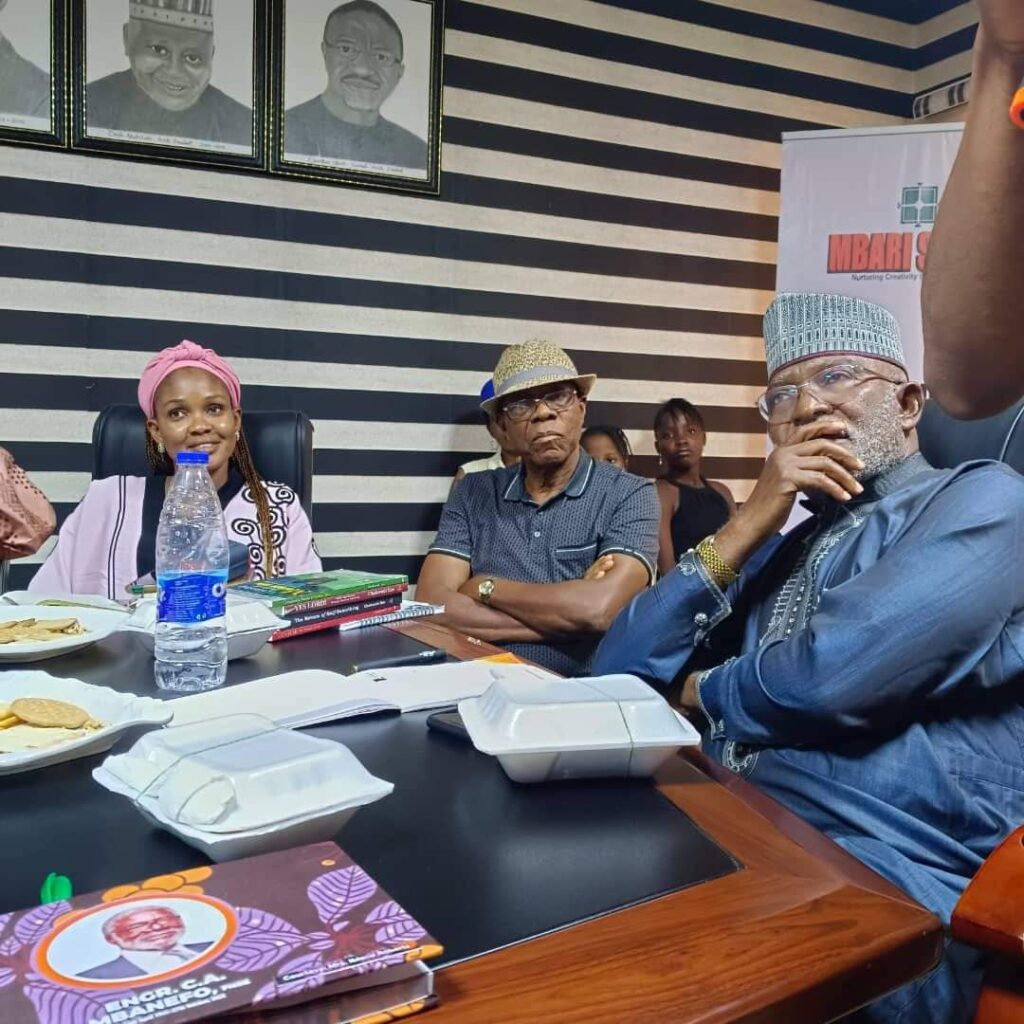
The lead discussant, Prof. Yakub related the power of choice to politics, especially as it relates to the two concepts, Power and
Choice.
According to him, choice can be used in various concepts, whether it is in one’s ability to choose between, or for something.
Prof. Udenta said the power of choice is time-sensitive, advising people to make their choices early enough so they can be able to make mistakes and correct them before it is too late.
“At 20 years you are not young, and so you should start early so that by the time you get to your 30s you must have accomplished something.
The lesson to learn is that the aggressive pursuit of your dream is founded on the possibility of your choice,” he advised.
Prof. Yakub who defined power as the ability to do anything, in his detailed paper, decried the abuse of power by those who are in leadership positions in Nigeria.
“Power and choice are important in our daily lives. Seeing that society has norms, we should ensure that we have the power to choose”
He reiterated the need for young generations to take up careers that can be impactful to themselves and others.
“The important thing is making the most out of your career not the money you made,” he advised.
Dr. Adams in her remarks recounted the choices she had to make in her career path and family, despite paternal influence.
Corroborating Prof. Yaqub’s submissions, she explained she never regretted all the choices she made as an undergraduate, mother, professional Journalist and creative writer.
“Making a choice means taking responsibility for any eventualities and when the moral and will power to make right choices are there the effects will end up being positive.
So, taking responsibility by working harder on the outcome of the choice one made is key in life. The best choice I made in life is going into humanities and charities with elderly people and people living with disabilities through my foundation,” she stated.
Dr. Orji, a retired English teacher and mother of eight female graduates, advised the females to live a godly and moral life. She encouraged university students who were present to imbibe the ability of writing.
Mbari Series is a centre for cultural activity by African writers, journalists, artists, dancers and musicians. It was founded in Ibadan, Nigeria, in 1961 by the University of Ibadan Famous creative minds, including Prof Wole Soyinka, Prof. Chinua Achebe, Christopher Okigbo, J.P. Clark, South African writer Ezekiel Mphahele, Frances Ademola, Demas Nwoko, Mabel Segun, Uche Okeke, Arthur Nortje, Bruce Onobrakpeya, and the legendary singer Fela Anikulapo Kuti.
Mbari, an Igbo diction means “creation”. One of the objectives of the Series is to nurture creativity through Literature, regardless of tribe, age, status and political and religious affiliations.